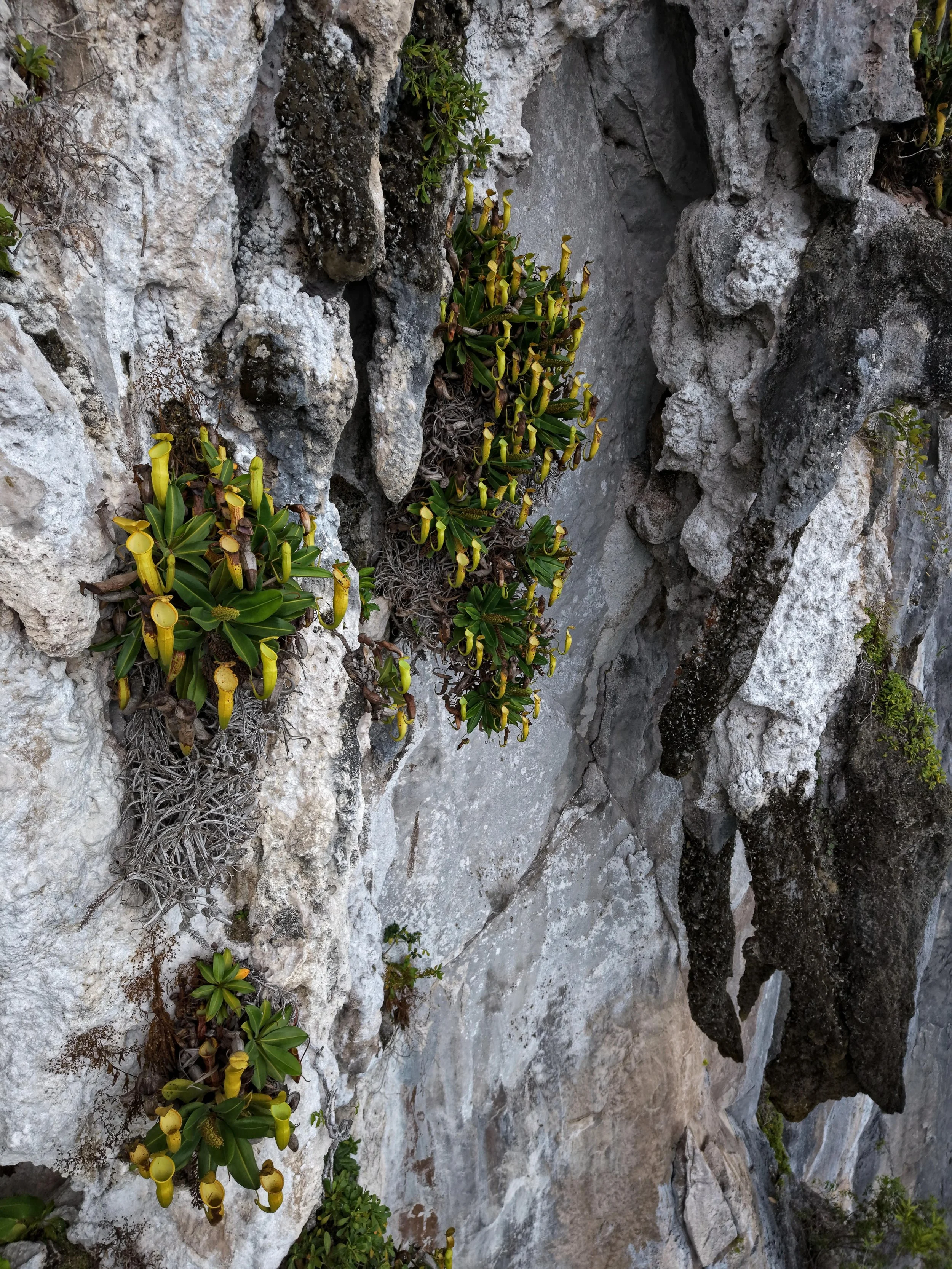

Nepenthes megastoma - Cliffside Perspective
Print Information
Photographs are printed on archival quality paper using professional inkjet printers. Prints have a UV resistant coating to ensure longevity. I print my photographs locally here in Denver, Colorado, and personally inspect each print before shipping.
Photo Information
DJI Mini 5 Pro | 50MP | 6144 x 8192 px | 8.67mm | ƒ/1.8 | 1/15 sec | ISO 140
Puerto Princesa Subterranean River National Park, Palawan, Philippines | 522 meters ASL
Sunday, August 9, 2026, ~10:30 AM PHT
Information
Species
Newly described on November 11, 2025 - Nepenthes megastoma is a fascinating and unique species addition to the Nepenthes genus. Originally discovered in 2013, it was thought to be an existing visually similar species, Nepenthes campanulata. Beginning in 2023, a team of taxonomists and botanists began studying the plants further. After 2 years of research, it was concluded to be a new species.
Nepenthes megastoma is critically endangered, as fewer than 50 mature specimens are found across only three known locations. This species is only found growing along vertical limestone walls in the Mount Saint Paul karst formation. Unlike most members of the genus, Nepenthes megastoma has a highly compact, branching growth habit, and has adapted to relatively dryer conditions.
The name ‘megastoma’ originates from Greek, meaning “large mouth” - ‘mega’ meaning ‘large’ and ‘stoma’ meaning ‘mouth.’ Pitcher shapes change throughout the seasons, a suspected evolutionary trait to more efficiently collect water. During the dry season, pitchers form with a wide mouth and bell-shaped body, while during the monsoon season pitchers form with a slimmer, more elongated shape. Ants are likely this plant's main prey, as numerous ants can be found crawling on the undersides of the pitcher lids.
Photograph Information
After an early morning start followed by a 4-hour drive from Puerto Princesa, I was able to photograph this exceptionally rare and little-photographed species. Flying over 2 kilometers (~1.3 miles) away and over 450 meters above ground level, I maneuvered the drone around a small mountain formation to locate the cliffside where there was a known population. Over the course of about 4 hours, I flew my drone back and forth using multiple batteries and charging the spent ones as I went. A quick nap or two may have happened while the batteries were charging!
The cliffside is severely uneven and steep - leading to incredibly strong and irregular gusts of wind that made photographing this species very difficult. In order to get close enough, I had to disable the drone’s built-in LiDAR obstacle avoidance system and fly manually. One strong gust of wind and the drone would have been toast! Thankfully, after logging over three and a half hours of flight time and over 100 gigabytes of raw footage and photos, I made my way back to Puerto Princesa for my flight back home!
Print Information
Photographs are printed on archival quality paper using professional inkjet printers. Prints have a UV resistant coating to ensure longevity. I print my photographs locally here in Denver, Colorado, and personally inspect each print before shipping.
Photo Information
DJI Mini 5 Pro | 50MP | 6144 x 8192 px | 8.67mm | ƒ/1.8 | 1/15 sec | ISO 140
Puerto Princesa Subterranean River National Park, Palawan, Philippines | 522 meters ASL
Sunday, August 9, 2026, ~10:30 AM PHT
Information
Species
Newly described on November 11, 2025 - Nepenthes megastoma is a fascinating and unique species addition to the Nepenthes genus. Originally discovered in 2013, it was thought to be an existing visually similar species, Nepenthes campanulata. Beginning in 2023, a team of taxonomists and botanists began studying the plants further. After 2 years of research, it was concluded to be a new species.
Nepenthes megastoma is critically endangered, as fewer than 50 mature specimens are found across only three known locations. This species is only found growing along vertical limestone walls in the Mount Saint Paul karst formation. Unlike most members of the genus, Nepenthes megastoma has a highly compact, branching growth habit, and has adapted to relatively dryer conditions.
The name ‘megastoma’ originates from Greek, meaning “large mouth” - ‘mega’ meaning ‘large’ and ‘stoma’ meaning ‘mouth.’ Pitcher shapes change throughout the seasons, a suspected evolutionary trait to more efficiently collect water. During the dry season, pitchers form with a wide mouth and bell-shaped body, while during the monsoon season pitchers form with a slimmer, more elongated shape. Ants are likely this plant's main prey, as numerous ants can be found crawling on the undersides of the pitcher lids.
Photograph Information
After an early morning start followed by a 4-hour drive from Puerto Princesa, I was able to photograph this exceptionally rare and little-photographed species. Flying over 2 kilometers (~1.3 miles) away and over 450 meters above ground level, I maneuvered the drone around a small mountain formation to locate the cliffside where there was a known population. Over the course of about 4 hours, I flew my drone back and forth using multiple batteries and charging the spent ones as I went. A quick nap or two may have happened while the batteries were charging!
The cliffside is severely uneven and steep - leading to incredibly strong and irregular gusts of wind that made photographing this species very difficult. In order to get close enough, I had to disable the drone’s built-in LiDAR obstacle avoidance system and fly manually. One strong gust of wind and the drone would have been toast! Thankfully, after logging over three and a half hours of flight time and over 100 gigabytes of raw footage and photos, I made my way back to Puerto Princesa for my flight back home!